What is style?
Some argue that style is nothing more than sticking to certain traits and repeating them until they become recognizable — in other words, style reduces to formalism. The British art critic and aesthetician Clive Bell insisted there must be a quality which, if absent, prevents an object from being called art; if present, it gives the work meaning. What is that quality, shared by all things, that stirs our aesthetic feeling? Bell’s answer: significant form — the distinctive arrangements of line and color and the relationships between particular forms that awaken our aesthetic response. So formal beauty is a key factor in establishing photography’s claim to art.
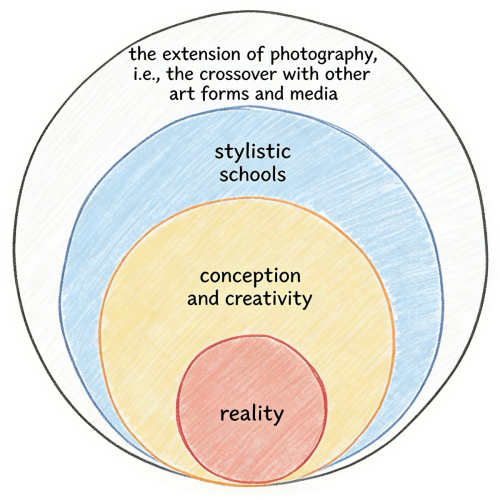
Over a century, many photographic styles have emerged and faded. Yet however photography evolves, its essence remains unchanged. Imagine it as a set of concentric circles: at the center sits truthfulness — the soul of photography. The outer rings show how photography fuses with other arts and media: combined with collage it becomes montage; with pop culture it becomes pop photography; tied to mass media it spawns creative genres like fashion and advertising photography. The more inner layers a practice contains, the firmer its identity as an independent art; the broader the outer rings, the richer its extensions and the more stylistic possibilities arise.
Those outer layers are unstable: new styles may settle and be absorbed into the inner circles over time, or they may vanish as history advances. Photography’s extensions are driven by many active forces that push outward and inward. We don’t know when a wholly new style — or a new art form — will appear, or when an internal stylistic mutation will produce a Van Gogh or Gauguin of photography. But as long as photography’s outer range keeps expanding and its core stays steady, the arrival of new styles is always something to anticipate.